Homeschool Arts and Crafts That Teach: Fun Ways to Blend Creativity and Learning
Arts and crafts can fill the table with paper scraps, paint cups, and glue sticks in minutes. They can also fill a homeschool day with real learning, if the project has purpose without losing the joy.
For homeschooling moms, the goal is not to turn every craft into a formal lesson. The better goal is to make creativity a steady part of learning. Children can measure, observe, compare, plan, tell stories, and solve problems while their hands are busy making something.

Start with a clear purpose, then keep the pressure low
A productive craft does not need to be complicated. It simply needs a small learning goal. Before choosing supplies, ask one quick question:
What will this project help my child practice?
That goal might be:
Fine motor control
Following multi-step directions
Color mixing
Pattern recognition
Storytelling
Measuring and comparing
Observing details in nature
Understanding a historical time period
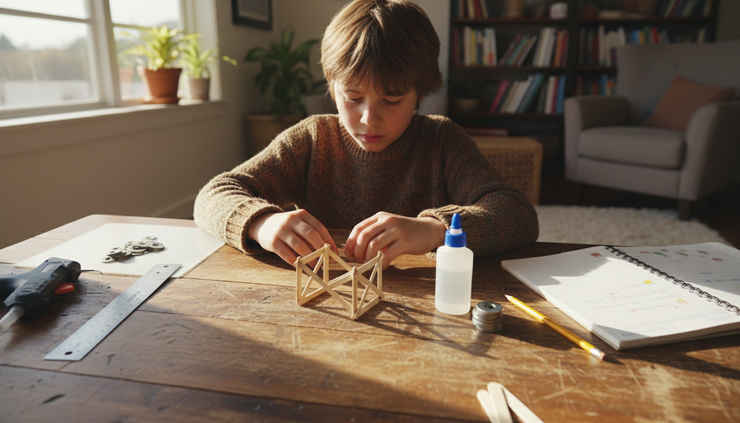
For younger children, the purpose may be as simple as “practice cutting straight and curved lines.” For older children, it might be “design a bridge from craft sticks and test how much weight it holds.”
Once the goal is clear, keep the tone relaxed. A child who feels watched or corrected at every step may stop experimenting. Give a short instruction, model one part if needed, then let the project breathe.
A helpful rhythm is:
Show the idea.
Name the learning goal.
Demonstrate one skill.
Let the child create.
Talk about the result.
That last step matters. A short conversation can turn a craft into a lesson. Ask, “What worked well?” or “What would you change next time?” Those questions build reflection without making the activity feel like a test.
Use many materials to build flexible thinking
Children learn a lot from handling different textures, weights, shapes, and tools. Paint teaches blending and brush control. Clay teaches form and pressure. Fabric scraps teach texture and layering. Recycled boxes teach structure and design.
A varied craft shelf does not need to be expensive. Some of the best supplies are simple household items:
Paper bags, cardboard tubes, and cereal boxes
Yarn, ribbon, string, and fabric scraps (https://amzn.to/3SZXIWh) (https://amzn.to/4AxPbef) (https://amzn.to/4xsuvkO)
Buttons, beads, craft sticks, and cotton balls (https://amzn.to/3UXhja7) (https://amzn.to/4Agi5iz) (https://amzn.to/4cKXgSm)
Aluminum foil, wax paper, and tissue paper (https://amzn.to/4hgaMz0) (https://amzn.to/3T6W5WD) (https://amzn.to/4j71d7L)
Leaves, twigs, shells, and small stones
Salt dough, air-dry clay, or homemade play dough (https://amzn.to/4j5iluG)
Using different materials also helps children discover their own creative preferences. One child may love detailed drawing. Another may prefer building. Another may come alive with messy paint or collage.
Try rotating supplies instead of putting everything out at once. Too many choices can overwhelm children. A tray with paper, glue, scissors, and three texture options is often enough.

Techniques matter too. Mix familiar favorites with new skills over time. Children can try:
Collage
Weaving
Printmaking with sponges or leaves
Paper folding
Sculpting
Sewing with large plastic needles
Watercolor washes
Resist art with crayons and paint
Stamping patterns
New techniques build patience. They also show children that there are many ways to solve a creative problem.
Connect crafts with math, science, and history
The strongest homeschool arts and crafts often connect naturally to other subjects. The project becomes a way to see the lesson, not just hear it.
Make math hands-on
Crafts are full of math. Patterns, shapes, fractions, symmetry, measurement, and spatial reasoning all show up around the art table.
Try these simple ideas:
Create paper quilts to practice fractions and geometric shapes.
Make beaded bracelets with repeating patterns.
Build 3D shapes from toothpicks and mini marshmallows.
Use rulers to design a city map on graph paper.
Fold paper into halves, fourths, and eighths before decorating.
For older children, add budgeting or scaling. Give a pretend supply budget for a project, or ask them to draw a room design where one inch equals one foot.
Turn science into something children can see
Science crafts work best when children observe, predict, test, and revise.
A few easy pairings include:
Make a butterfly life cycle wheel while studying insects.
Build a simple weather chart with movable symbols.
Create a solar system model and compare planet sizes.
Paint with ice cubes to discuss states of matter.
Design a paper airplane and test how folds change flight.
The learning comes from the discussion. Ask, “What do you think will happen?” before the experiment-craft begins. Afterward, ask, “What did you notice?”
Bring history off the page
History can feel far away until children make something connected to a time, place, or culture. Keep projects respectful and focused on learning, not stereotypes.
Children might:
Make a timeline accordion book.
Create a salt dough map of a region they are studying.
Design a coat of arms while learning about medieval Europe.
Try simple weaving while discussing everyday life in early communities.
Make a covered wagon model during a study of westward expansion, while also talking honestly about the people affected by that movement.
Crafts can help children remember details because they connect facts with touch, color, and story.
Balance guided projects with free expression
Structured crafts teach children to follow directions, practice a skill, and complete a plan. Free art teaches decision-making, imagination, and confidence. A strong homeschool routine needs both.
A guided project might have a clear end result, such as a paper mosaic, a diorama, or a labeled science model. These projects are useful when the goal is accuracy, sequence, or a specific technique.
Free expression gives the child more control. Set out supplies and a loose prompt, then step back. For example:
“Create something that shows how rain feels.”
“Build an animal that could survive in the desert.”
“Make a picture using only circles and lines.”
“Use these scraps to invent a machine.”
This balance keeps homeschool arts and crafts from becoming either too rigid or too chaotic. Some days need a planned project. Other days need open-ended creating.
One practical approach is to use a weekly pattern:
Guided project
Open studio time
Skills practice
Display or reflection
Connects to a current lesson and teaches a specific skill
Lets children choose supplies and create freely
Focuses on one technique, such as cutting, shading, folding, or sewing
Gives time to share, explain, revise, or celebrate finished work
Reflection does not need to be formal. A child can dictate a sentence about the project, label parts of a model, or tell the story behind a drawing.
Make setup and cleanup part of the lesson
Craft time feels more peaceful when children know where things go and what comes next. A simple system saves energy and teaches responsibility.
Try creating a basic craft routine:
Cover the table.
Set out only the supplies needed.
Keep water, wipes, or a damp cloth nearby.
Use a tray for small items.
Place finished projects in one drying area.
Clean up before moving to the next subject.
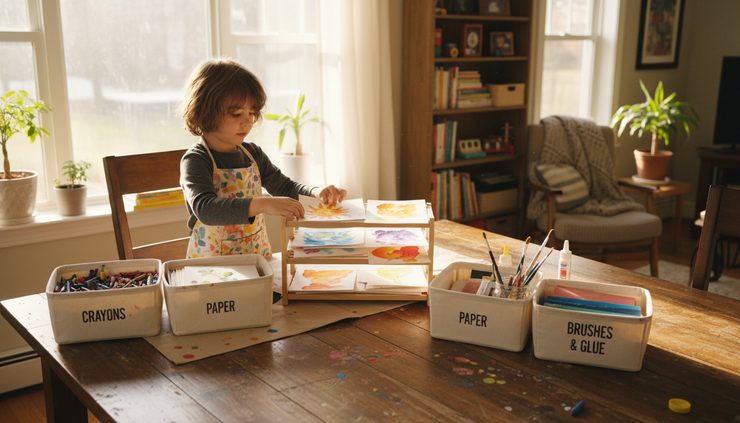
Children can help more than they often do. Even preschoolers can sort crayons, stack paper, or carry scraps to the trash. Older children can wash brushes, restock supplies, and label storage bins.
A “finished or not finished” basket also helps. Some projects take more than one sitting. Instead of rushing, place unfinished work in the basket and return to it later. This teaches children that careful work can take time.
Keep craft time joyful and meaningful
The best craft lessons leave room for surprise. The paint colors may blend in an unexpected way. The cardboard tower may fall and need a stronger base. The history notebook may turn into a pop-up book because a child has a better idea.
That is not wasted time. That is learning.
A productive arts and crafts routine does not require perfect projects or a closet full of specialty supplies. It grows from clear goals, varied materials, thoughtful subject connections, and enough freedom for children to make real choices.
Start small this week. Choose one lesson, add one creative project, and ask one good question when the work is done. The craft may last an hour, but the learning can stick much longer.
Comments