Sudoku for Brain Health: Boost Memory, Cognitive Skills and Problem Solving
A Sudoku grid looks simple at first: nine rows, nine columns, and a handful of numbers already in place. Then the brain starts working. You compare possibilities, hold patterns in mind, rule out wrong moves, and test your next step. That quiet little puzzle can turn into a full mental workout.
Sudoku will not “cure” memory problems or guarantee lifelong brain health. No puzzle can do that on its own. Brain health depends on sleep, movement, nutrition, social connection, stress management, and medical care when needed. Still, research suggests that mentally stimulating activities can support cognitive function, and Sudoku is one of the easiest ways to make that stimulation part of daily life.
The appeal is practical. Sudoku is cheap, portable, screen-free if you want it to be, and scalable. A beginner puzzle can take five minutes. A harder grid can challenge even experienced solvers. That makes it a strong habit for anyone who wants to keep the mind active without turning self-improvement into a chore.

Why Sudoku gives the brain a useful workout
Sudoku is often described as a numbers game, but math is not really the point. Most puzzles require no arithmetic at all. The numbers are symbols. The real task is logic.
Each move asks the brain to answer a set of questions:
Which numbers are already used in this row?
Which numbers are missing from this column?
What can fit inside this 3x3 box?
If a number can go in two places, what would each choice affect?
Which clue unlocks the next safe move?
That process trains several cognitive skills at once. Attention helps you scan the grid without missing clues. Working memory helps you hold possible numbers in mind. Pattern recognition helps you spot repeated structures. Inhibitory control helps you resist guessing too soon.
Researchers often group these abilities under “executive function,” the mental system involved in planning, flexible thinking, and self-control. Sudoku is not the only way to activate executive function, but it does so in a clean and structured way. Every square has one correct answer, and every answer must fit the whole grid.
This is what makes Sudoku satisfying. It gives immediate feedback. A good move opens the puzzle. A careless move creates conflict. Over time, the brain learns to slow down, compare evidence, and choose better strategies.
That kind of practice matters because the brain responds to repeated challenge. Neuroscientists often use the term neuroplasticity to describe the brain’s ability to change through experience. Learning a new puzzle method, practicing it, and gradually taking on harder grids gives the brain a reason to adapt.
What research says about puzzles and cognitive health
The science around Sudoku is promising, but it needs careful wording. Studies do not show that Sudoku alone prevents dementia or stops cognitive decline. What they do show is more measured: people who often engage in mentally stimulating activities tend to perform better on certain cognitive tests, and structured cognitive training can improve trained skills.
One large observational project from researchers at the University of Exeter and King’s College London, using data from the PROTECT study, found that adults over 50 who regularly did number puzzles tended to show stronger performance on tests of reasoning, attention, and memory. The study cannot prove that puzzles caused the better scores. People who choose puzzles may also differ in education, health, lifestyle, or motivation. Even so, the link supports the idea that number puzzles are part of a brain-active lifestyle.
The ACTIVE study, a well-known clinical trial on cognitive training in older adults, also adds useful context. It did not test Sudoku specifically. Instead, it studied targeted training in memory, reasoning, and processing speed. Participants showed improvement in the skills they practiced, and some benefits lasted over time. The takeaway is not that all brain games work the same way. It is that repeated cognitive practice can improve specific mental skills.
Expert groups that focus on aging and brain health tend to recommend variety rather than a single brain game. The Global Council on Brain Health, for example, has emphasized staying mentally engaged through learning, challenge, and social activities. Sudoku fits that advice when it remains challenging and enjoyable.
There is also the idea of cognitive reserve. This term refers to the brain’s ability to cope with age-related changes or damage by using flexible mental strategies. Education, complex work, hobbies, learning, and social engagement may all contribute. Sudoku may be one small piece of that larger pattern, especially when paired with reading, exercise, conversation, and new skills.
The clearest scientific message is simple: mentally challenging activities appear to support brain function best when they are regular, varied, and just difficult enough to require effort.
This article is informational only and is not medical advice. Anyone with concerns about memory changes, confusion, or cognitive decline should speak with a qualified health professional.
How Sudoku can support memory
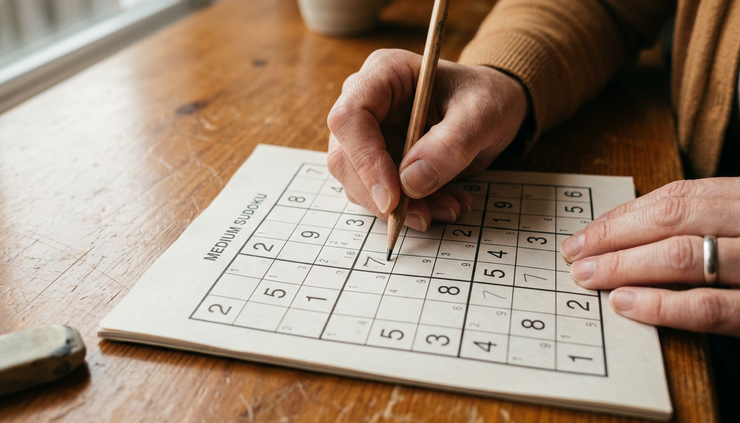
Memory is not one single skill. Sudoku mainly engages working memory, the short-term mental space used to hold and manage information. When solving a puzzle, you may keep track of a pattern such as “7 must be in one of these two cells” while checking another row. That is working memory in action.
Sudoku also uses prospective memory in a small way. You notice a clue, move to another part of the grid, then return to apply what you noticed. Experienced solvers often build a mental map of the puzzle. They remember which boxes are nearly complete and which numbers seem restricted.
This does not mean Sudoku will make someone remember names, appointments, or where they left their keys. Memory skills do not transfer perfectly from one task to every part of life. A person can become much better at Sudoku without becoming better at every memory task.
Still, the puzzle can train useful habits that support memory day to day:
Slowing down before acting
Checking details carefully
Grouping information into patterns
Returning to unfinished clues
Noticing when an assumption caused an error
These habits matter because memory often fails when attention fails first. If a person rushes, multitasks, or never fully encodes information, recall becomes harder. Sudoku rewards careful attention. It teaches the brain to pause and register details.
There is also an emotional benefit. Completing a puzzle can create a small sense of mastery. That feeling can help people stick with a routine. A habit that feels rewarding is easier to repeat, and repetition is the key to any cognitive benefit.
For many people, this is the real value of Sudoku for brain health: it turns focused mental effort into a pleasant ritual.
How Sudoku builds problem-solving skills
Good Sudoku solving depends on logic, not luck. Guessing may work on easy puzzles, but it usually creates trouble as grids get harder. The better approach is to learn repeatable strategies.
A beginner might start by scanning rows, columns, and boxes for missing numbers. Then come simple techniques:
Single candidates
A square has only one possible number based on its row, column, and box.
Hidden singles
A number can go in only one place within a row, column, or box, even if that square has several possible candidates.
Pencil marks
Small notes show which numbers could fit in each empty square.
Pairs and triples
Two or three squares share the same limited set of candidates, which helps remove those numbers from other squares.
These methods teach a core problem-solving habit: reduce uncertainty. Instead of staring at the whole puzzle, the solver narrows the field. Which section has the most information? Which number is most restricted? Which clue affects the most cells?
That approach carries over to many everyday challenges. A cluttered problem becomes easier when broken into constraints, options, and next steps. Sudoku trains that mental rhythm in a low-pressure setting.
It also builds tolerance for frustration. Hard puzzles often stall. That pause can be useful. The solver learns to switch sections, look for a new pattern, or review earlier assumptions. This flexible thinking is central to problem solving.
A healthy Sudoku routine also encourages metacognition, which means thinking about your own thinking. For example:
Did I make progress because I used a clear strategy?
Did I make a mistake because I guessed?
Which clue did I overlook?
What pattern appears often in this puzzle level?
That self-checking process helps turn puzzle time into skill-building time.

How beginners can start without getting frustrated
Sudoku can feel intimidating when the grid is mostly blank. The best way to start is to make the first wins easy. Choose beginner puzzles and build confidence before moving up.
Start with one rule: each row, column, and 3x3 box must contain the numbers 1 through 9 with no repeats. That is the whole foundation.
Then use a simple beginner routine.
Scan for nearly finished areas
Look for rows, columns, or boxes that already have many numbers filled in. If a row has seven numbers, only two are missing. That is easier than working from an empty area.
Ask, “What numbers are missing?” Then test each missing number against the crossing columns and boxes.
Work one number at a time
Pick a number, such as 5, and scan the whole grid. In each 3x3 box, ask where 5 could go. Existing 5s in nearby rows and columns will block certain spaces.
This method helps beginners see patterns without juggling too many numbers at once.
Use pencil marks, but keep them tidy
Candidate notes are helpful, especially as puzzles get harder. Write small possible numbers in empty squares. If the notes become messy, erase and refresh them.
For printed puzzles, use a pencil. For apps, turn on candidate mode if available. The goal is not to fill every square with tiny numbers. The goal is to record useful possibilities.
Avoid guessing early
Guessing can be tempting, but it turns a logic puzzle into a coin toss. If a guess is wrong, the error may not show up until much later.
Instead, look for a move you can prove. A safe move teaches more than a lucky one.
Stop before fatigue sets in
A short, focused session beats a long, irritated one. Ten minutes of clear thinking is enough to build the habit. If the puzzle stops being fun, take a break and return later.
Many solvers find that a fresh look reveals a clue they missed.
How to make Sudoku part of a brain-healthy routine
The best puzzle habit is the one that fits naturally into the day. Sudoku does not need a big time block. It works well as a small ritual.
Try one of these simple routines:
One easy puzzle with morning coffee
Ten minutes after lunch instead of scrolling
A printed puzzle before bed, especially if screens disturb sleep
One medium puzzle on weekends
A shared puzzle with a friend or family member
Variety helps. If Sudoku becomes automatic, the brain works less. Rotate puzzle difficulty or mix Sudoku with crosswords, reading, card games, music practice, language learning, or strategy games. The brain benefits from challenge, novelty, and consistency.
A balanced brain-health routine might include:
Habit | How it helps |
Sudoku or logic puzzles | Trains attention, working memory, and reasoning |
Physical activity | Supports blood flow, mood, sleep, and overall health |
Social connection | Engages language, emotion, and memory |
Learning something new | Builds flexible thinking and persistence |
Sleep | Helps memory consolidation and mental clarity |
Sudoku should feel like a challenge, not a test of worth. Some days the puzzle will fall into place. Other days it will resist every move. That is normal. The value comes from returning to the grid, trying a better strategy, and practicing careful thought.
For beginners, progress may look like fewer guesses, cleaner notes, or finishing an easy puzzle with confidence. For experienced solvers, progress may mean moving to harder grids or learning advanced techniques.

Keep the challenge enjoyable
Sudoku is not magic, but it is meaningful. It asks the brain to focus, remember, compare, reason, and recover from mistakes. Those skills matter at every age.
The strongest case for Sudoku is not that it guarantees a sharper mind. The stronger case is that it makes mental exercise easy to repeat. A grid, a pencil, and a few quiet minutes can create a habit of paying attention and solving problems with patience.
Start small. Choose an easy puzzle. Notice one pattern. Finish if you can, pause if you need to, and come back tomorrow. Over time, those small challenges add up to a brain that stays curious, active, and ready for the next square.


Comments