5 Easy Homeschool Crafts for Toddlers to Build Fine Motor Skills and Learn Through Play
A toddler can turn a paper plate, a few pom-poms, and a cardboard tube into a full morning of learning. The best part is that toddler crafts do not need to look perfect. They work best when little hands are busy pinching, peeling, squeezing, sorting, sticking, and exploring.
Homeschool crafts for toddlers are less about making a polished project and more about building skills through play. When a child tears paper, presses stickers, drops buttons into a cup, or paints with a sponge, they are practicing the small hand movements they will later use for drawing, dressing, cutting, and writing. (Please be sure to monitor your toddler very closely when doing crafts so there is no danger to them).
The five crafts below use simple materials you may already have at home. Each one includes easy steps, learning benefits, and parent tips to keep the activity calm, safe, and fun.

Set up toddler crafts for success
Before starting, keep the setup simple. Toddlers often engage longer when they can see a few clear choices instead of a table crowded with supplies.
A helpful craft setup might include:
A washable tablecloth, old towel, or baking sheet
Two or three materials at a time
A small tray or bowl for loose pieces
Child-safe tools
A damp cloth nearby for quick cleanup
For toddlers, process matters more than outcome. A flower may become a cloud. A caterpillar may only have one eye. That is fine. The learning happens in the choosing, squeezing, sticking, and trying again.
Keep safety in mind, too. Small items like buttons, beads, dry pasta, and pom-poms can be choking hazards. Stay close, choose larger materials when needed, and skip tiny pieces if a child still mouths objects.
1. Make a sticky paper collage with scraps and shapes
This craft is perfect for toddlers who like stickers but are not quite ready for glue. Contact paper creates a sticky surface that lets children place and move materials while strengthening their fingers.
What you need
Clear contact paper (https://amzn.to/4gB79Dm)
Masking tape or painter’s tape (https://amzn.to/4y1WhWb)
Tissue paper, construction paper, or magazine scraps (https://amzn.to/4y5AuwQ)
Large fabric scraps, yarn pieces, or foam shapes (https://amzn.to/4curU2r)
Optional cardboard frame
How to do it
Cut a sheet of contact paper.
Peel off the backing.
Tape the contact paper to the table, sticky side up.
Place paper scraps and soft materials in a small bowl.
Invite your toddler to press pieces onto the sticky surface.
When finished, cover it with another sheet of contact paper or tape it to a window.
What toddlers practice
This simple activity builds fine motor control through grasping, pinching, and pressing. Toddlers also learn about texture, color, and shape as they decide where each piece belongs.
You can turn it into a gentle learning game by naming what your child chooses.
“That piece is yellow.”
“You picked the soft yarn.”
“This triangle is going near the blue paper.”
Parent tips
Cut the scraps ahead of time if your toddler gets frustrated easily. If they enjoy tearing, offer strips of paper and let them rip the pieces themselves. Tearing paper is excellent hand work and often very satisfying for toddlers.
For a seasonal twist, use orange and brown paper for fall leaves, green and red pieces for a holiday collage, or pastel scraps for spring flowers.
2. Paint with cotton balls and clothespins
Toddlers love paint, and this version adds a fine motor boost. Clipping cotton balls with clothespins turns a basic painting activity into a playful hand-strengthening exercise.

What you need
Cotton balls (https://amzn.to/4hQj7LD)
Clothespins (https://amzn.to/4wQiiWT)
Washable paint (https://amzn.to/3SUdou0)
Paper
Small plates or shallow containers
How to do it
Clip one cotton ball into each clothespin.
Pour small amounts of washable paint onto plates.
Show your toddler how to dab the cotton ball into paint.
Let them stamp, swirl, tap, and drag paint across the paper.
Offer a fresh cotton ball when colors get muddy or the first one falls apart.
Set the painting aside to dry.
What toddlers practice
Opening and closing a clothespin strengthens the small muscles in the hands. Dabbing and stamping also support hand-eye coordination. As toddlers explore the paint, they learn cause and effect.
When they press lightly, they get small marks. When they press harder, they get bigger splats. That is science in toddler form.
Parent tips
Use only two paint colors at first. Too many choices can quickly turn into a brown puddle, which is not a problem, but it may shorten the activity.
If your toddler is new to paint, model one or two simple motions:
Tap, tap, tap
Slide across the page
Make dots around the edge
Cover the whole paper
Then step back. Toddlers often discover their own methods when adults leave room for experimentation.
You can also tape the paper to the table to keep it from sliding. This helps younger toddlers focus on the painting motion instead of chasing the paper.
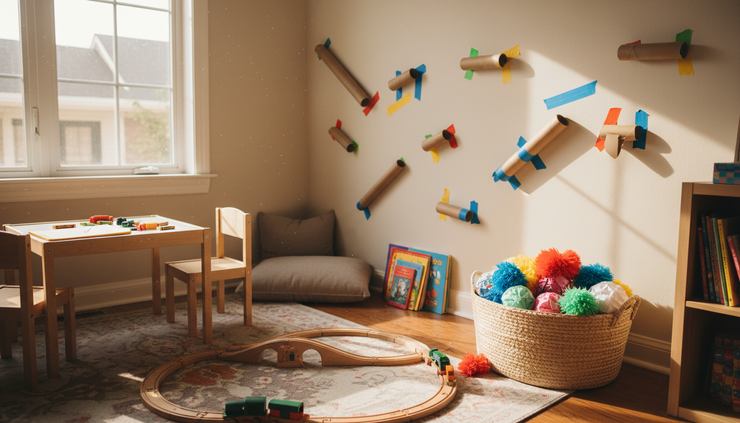
3. Build a cardboard tube drop game
This craft combines making and playing. After a few minutes of decorating, toddlers can use the cardboard tube drop again and again.
What you need
Empty paper towel tubes or toilet paper tubes
Painter’s tape (https://amzn.to/4y1WhWb)
Pom-poms, large buttons, or crumpled paper balls
A bowl or basket
Crayons or stickers for decorating (https://amzn.to/4xnrPG5)
How to do it
Let your toddler decorate the cardboard tubes with crayons or stickers.
Tape the tubes vertically or diagonally to a wall, cabinet, or refrigerator.
Place a basket or bowl under the tubes.
Give your toddler large pom-poms or crumpled paper balls.
Show them how to drop one item into the top of the tube.
Let them collect the pieces and repeat.
What toddlers practice
This activity supports pincer grasp, hand-eye coordination, and tracking. Toddlers must line up the object with the tube opening, release it, watch it fall, and find where it lands.
It also introduces early problem-solving. If the pom-pom gets stuck, your toddler may shake the tube, poke it gently, or try a smaller item.
Parent tips
Use larger items for younger toddlers. Crumpled paper balls are a great choice because they are light, easy to grab, and safe for supervised play.
You can adjust the challenge by changing the angle of the tubes. A straight vertical tube is easier. A diagonal tube makes the object move in a new way and adds excitement.
Try simple prompts while your child plays:
“Can you drop the red one?”
“Where did it go?”
“Let’s try two balls.”
“Which tube is faster?”
This craft is also great for toddlers who need movement. They can squat, reach, collect, and repeat while still working on fine motor skills.
4. Create paper plate faces with feelings
Paper plate faces invite toddlers to explore creativity, body parts, and emotions. They can make happy faces, silly faces, surprised faces, or faces that change as they glue pieces down.
What you need
Paper plates
Crayons or washable markers (https://amzn.to/4wMiWoo)
Glue stick (https://amzn.to/4xl8RQt)
Paper circles, yarn, or fabric scraps
Large googly eyes if safe and supervised (https://amzn.to/4xndKZh)
Optional child-safe scissors for older toddlers (https://amzn.to/45JATZI)
How to do it
Give your toddler a paper plate.
Talk about face parts while pointing to your own face.
Offer paper shapes for eyes, nose, mouth, hair, and ears.
Let your toddler place the pieces before gluing.
Help them use a glue stick if needed.
Add crayon marks for cheeks, eyebrows, or extra details.
What toddlers practice
Gluing, placing, and pressing paper pieces help toddlers develop finger strength and coordination. This craft also builds language. Words like eyes, nose, mouth, happy, sad, surprised, and silly become meaningful because toddlers can see and create them.
The activity also supports social-emotional learning. Toddlers start to connect facial expressions with feelings, which helps them name their own emotions.
Parent tips
Do not worry if the eyes end up near the chin or the mouth lands on the forehead. That playful placement is part of toddler thinking. You can gently name what they did without correcting every choice.
Try saying:
“You put the eyes down low. This face looks very silly.”
“That mouth is big. Is this face surprised?”
“I see lots of hair on top.”
If your toddler resists glue, let them make temporary faces without sticking anything down. They can move the pieces around like a puzzle. The learning still counts.
For extra play, make a face together and act out the feeling. A surprised face can gasp. A happy face can clap. A sleepy face can pretend to yawn.
5. String chunky pasta necklaces
Stringing activities are classic for a reason. They build concentration, hand control, and patience. For toddlers, large pasta shapes and a sturdy string make the task much easier.

What you need
Large tube pasta, such as rigatoni
Yarn, shoelace, or pipe cleaner
Tape
Washable markers or paint (https://amzn.to/4idn0KT)
Optional large wooden beads (https://amzn.to/4wRNLIj)
How to do it
Cut a short piece of yarn.
Wrap tape around one end to make it stiff.
Tie a large pasta piece to the other end as a stopper.
Let your toddler color the pasta with washable markers.
Show them how to push the taped end through the pasta.
Pull the pasta down the string.
Repeat until the necklace or bracelet is the right size.
Tie the ends together if your child wants to wear it.
What toddlers practice
Stringing develops bilateral coordination, which means using both hands together. One hand holds the pasta while the other pushes the string through. This takes focus, control, and planning.
It also encourages pattern play. Older toddlers may enjoy making simple patterns like red, blue, red, blue. Younger toddlers may simply enjoy filling the string, which is just as valuable.
Parent tips
If yarn is too floppy, use a pipe cleaner. It holds its shape and makes stringing easier. A shoelace also works well because the plastic tip is easy for small hands to guide.
Keep the string short at first. A long necklace can feel overwhelming, while a small bracelet gives toddlers a quick win.
Offer language without turning the craft into a quiz:
“You added one more.”
“That pasta went all the way down.”
“You are using both hands.”
If your toddler loses interest after three pieces, stop there. A three-piece necklace is still a success.
How to make craft time feel easier for everyone
Toddler craft time does not have to fill an entire afternoon. Ten focused minutes can be plenty. The goal is to create a space where your child can explore and where you can enjoy the process, too.
Here are a few ways to make it smoother:
Choose one main skill
Pick squeezing, sticking, tearing, stamping, or stringing. A focused craft is easier to set up and easier for toddlers to understand.
Use small amounts
A tablespoon of paint, a handful of pom-poms, or five paper shapes can be enough. You can always add more.
Model, then pause
Show the action once or twice. Then let your toddler try, even if they do it differently.
Describe instead of direct
Say what you see. “You pressed the blue paper.” “You made little dots.” This builds language without taking over.
Expect repetition
Toddlers learn by doing the same action again and again. Dropping twenty pom-poms through a tube is not wasted time. It is practice.
Plan for cleanup
Keep wipes, a damp cloth, and a small trash bowl nearby. If cleanup is simple, you will be more likely to try crafts again.
A simple weekly craft rhythm
If you homeschool with a toddler nearby, a loose rhythm can help. You do not need a full craft curriculum. Try choosing one craft style for each day you want hands-on play.
Day | Simple craft focus | Easy idea |
Monday | Tearing and sticking | Contact paper collage |
Tuesday | Painting | Cotton ball stamping |
Wednesday | Dropping and sorting | Cardboard tube game |
Thursday | Gluing and naming | Paper plate faces |
Friday | Stringing | Pasta necklace |
This rhythm gives toddlers variety while keeping the materials familiar. Familiar supplies build confidence. Once your child knows how glue sticks, tape, paint, and yarn work, they can use them in more creative ways.
Keep the focus on connection
The best toddler crafts are simple enough that adults can relax. Sit nearby. Name colors. Laugh at the wobbly faces. Offer help when little hands get stuck, but let the project belong to the child.
These 5 easy homeschool crafts for toddlers to build fine motor skills and learn through play can fit into an ordinary morning with very little prep. Start with one activity, use what you have, and let your toddler show you where the play wants to go.
A few scraps, a cardboard tube, or a bowl of pasta may not look like much at first. In a toddler’s hands, they become tools for building confidence, creativity, and joyful learning.
Comments